The Rise of the Phoenix: How AI Expertise Rescued a Failing Computer Vision Project in Smart Manufacturing
How Mindtrace turned a stalled arc weld inspection system into a production-grade AI quality platform
In automotive manufacturing, the difference between a successful production deployment and a costly experiment often comes down to one thing — expertise. The right technology is important, but it’s how that technology is applied, integrated, and optimized that determines real-world success. Across the industry, many computer vision systems for quality inspection show promising results during pilot projects, only to struggle when exposed to the variability, scale, and speed of real production environments.
This is a story that played out recently on a high-throughput arc welding inspection line, where a project that started with promise quickly stalled — until Mindtrace stepped in.
Key Takeaways:
- Many computer vision quality inspection systems perform well in pilot projects but fail in real production environments due to variability, throughput demands, and rigid AI tools.
- A major automotive OEM faced this challenge when an arc welding inspection system stalled at 80% detection accuracy and cycle times far beyond TAKT requirements.
- Mindtrace recovered the project using its Brain-Sense™, NeuroForge™, and Inspectra™ platforms, enabling adaptive AI and faster inspection workflows.
- Within four weeks, the system achieved production-grade accuracy and was deployed across multiple lines.
The Problem: When “Safe” Choices Fail
While many computer vision initiatives show early promise in controlled pilots, the real test comes when those systems are pushed into high-throughput production environments. That’s exactly what happened on this arc welding inspection line. A major automotive OEM partnered with a system integrator to deploy a computer vision defect detection solution for arc weld quality inspection. The integrator promised a leaner setup — fewer cameras, robotic capture, and off-the-shelf industrial vision hardware paired with “AI software.”
It looked efficient on paper. It even felt safe.
After all, these were well-known industrial camera brands — pre-approved at most plants — and the bundled software had “AI” on the label. The integrator’s proposal seemed cost-effective, simple, and less intrusive to the existing cell design.
But as production trials began, the flaws surfaced.
Despite early signs of promise (around 80% detection accuracy out of the box), performance plateaued. The system could not cross the 98% accuracy threshold required for automotive weld inspection. Worse, the robotic capture process was running three times slower than the TAKT time, threatening throughput targets.
Two problems emerged:
- The integrator lacked true AI expertise — they could install cameras but not optimize the learning system.
- The “AI software” bundled with the cameras was rigid and limited, making it nearly impossible to tune or retrain models effectively.
After months of missed milestones and rising frustration, the OEM had seen enough. The integrator was dismissed and the project was handed to Mindtrace for rescue which we aptly named — Phoenix.
The Mindtrace Difference: AI-First Thinking Meets Real-World Manufacturing
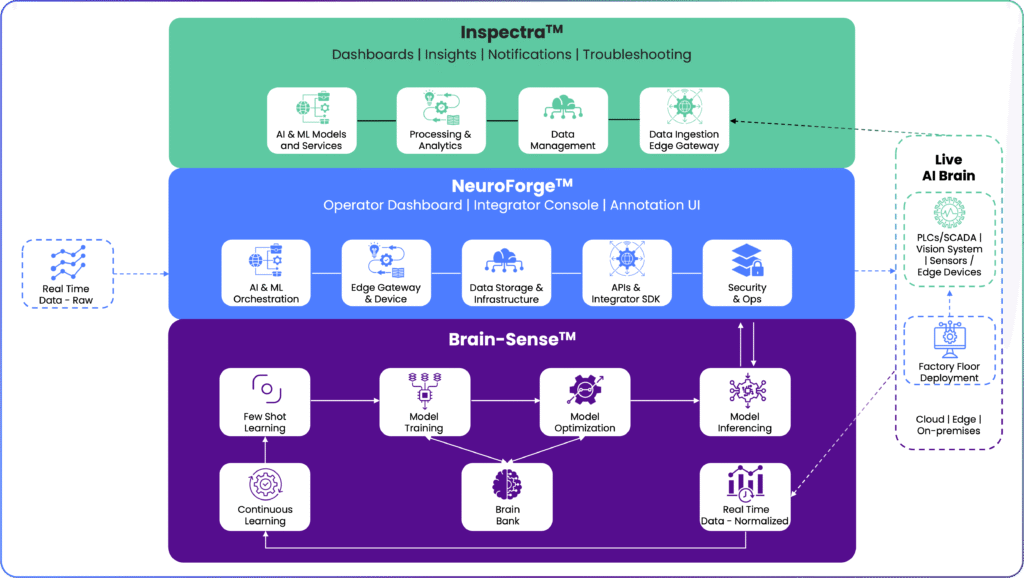
Where most vision providers start with cameras and work backwards to AI, Mindtrace starts with intelligence — an AI-first approach built around its Smart Manufacturing Platform, which includes Brain-Sense™, NeuroForge™, and Inspectra™.
This foundation allows Mindtrace to deliver fit-for-purpose computer vision solutions that integrate seamlessly into complex production environments — whether the requirement is physical isolation, sub-second inference, or traceable defect analytics.
For the Phoenix project, Mindtrace deployed a structured recovery workflow powered by its proprietary platforms:
- Pre-trained “Brains” from Brain-Sense™ to assess existing image quality and model readiness within hours, not weeks.
- NeuroForge™ tools to recalibrate the capture methodology, blending static and robotic imaging for optimal coverage and cycle time alignment.
- Inspectra™ analytics to mine insights from existing defect data, refine ground truth, and uncover root causes of anomalies.
- Self-supervised learning loops to accelerate fine-tuning of the models using only the customer’s real production images.
- Agent-driven optimization to balance detection accuracy and TAKT time automatically through iterative model updates.
Within four weeks, the project was fully recovered — meeting gauge R&R validation, achieving production-grade accuracy, and going live across multiple lines with data-driven performance insights.
Why It Worked: Expertise + Adaptable AI
What set Mindtrace apart wasn’t just better algorithms — it was the combination of:
- Manufacturing integration expertise, built through collaborations with leading automation partners like Paslin, R&E, and VRSI.
- Adaptable AI technology, able to learn continuously from new process data.
- Analytics that close the loop, turning inspection feedback into actionable process intelligence.
This end-to-end approach — from NeuroForge™ integration to Inspectra™ analytics — ensures that AI doesn’t just spot defects but improves the manufacturing process itself.
The Takeaway: From Experiment to Excellence
The Phoenix project became more than a technical recovery — it became proof that AI in manufacturing requires both depth and discipline.
When implemented by experts who understand the intersection of AI, automation, and production realities, computer vision transforms from a costly experiment into a scalable, high-ROI quality platform.
At Mindtrace, that’s what an AI-first approach means:
✅ Building intelligence that learns from your processes.
✅ Integrating seamlessly with your manufacturing systems.
✅ Delivering measurable gains in accuracy, speed, and yield.
Mindtrace: where Physical AI meets real-world production.