The Harsh Reality: Why Computer Vision for Quality Inspection Often Fails Beyond the Pilot Project
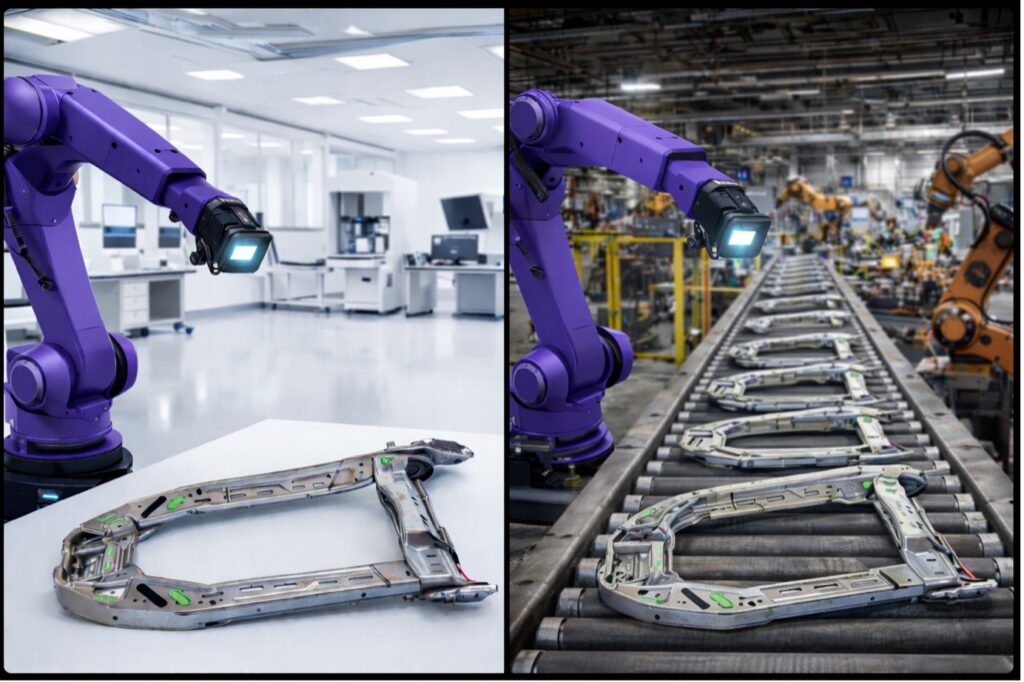
It’s a story we hear all too often: a factory floor buzzing with the promise of computer vision, a pilot project showing incredible accuracy, and then… a frustrating grind as that promise crumbles in the face of real-world application. At Mindtrace, we’ve seen countless organizations grapple with this, whether they’re leveraging established players like Keyence and Cognex, or working with vision integrators dabbling in AI platforms. The truth is the gap between lab success and production reliability in quality inspection is a chasm.
The Illusion of “Off-the-Shelf” AI: Keyence, Cognex, and the Integrator’s Dilemma
Companies like Keyence and Cognex have revolutionized industrial automation with powerful vision hardware and increasingly sophisticated software suites, including their own AI capabilities. Similarly, many vision integrators now offer solutions built on popular cloud AI platforms. These tools are excellent for many tasks, but they often stumble when confronted with the nuanced, ever-changing reality of a production line.
Here’s why:
- Rigidity in the Face of Variation:
- The Problem: Manufacturing environments are inherently dynamic. Slight changes in lighting, product orientation, material finishes, dust accumulation, or even minor process variations can introduce “novelty” that wasn’t present in the training data.
- Off-the-Shelf Limitation: Traditional vision systems and many cloud-based AI models are trained on a fixed dataset. When they encounter variations outside this narrow scope, their performance degrades rapidly because they lack the inherent ability to adapt or understand “context.” A scratch might look different based on the angle of light, or a perfectly acceptable material imperfection might be flagged as a defect simply because the model hasn’t seen that specific permissible variance before.
- Example: A system trained to spot scratches on a pristine, uniformly lit widget suddenly sees false positives when the widget material changes supplier, altering its reflectivity.
- The “Black Box” Problem and Lack of Explainability:
- The Problem: When a vision system flags a product, “Why was this flagged?” is the most critical question. Was it a real defect, or a measurement anomaly? Was the part incorrectly presented?
- Off-the-Shelf Limitation: Many AI solutions, especially deep learning models, are notoriously opaque. They provide a “yes/no” or a “pass/fail” without insight into the specific features or reasoning. This makes debugging incredibly difficult and trust hard to build on the factory floor. Operators quickly lose faith if they can’t understand or verify the system’s judgments.
- Example: A conveyor belt is stopped because of a “failed” part, but the operator can’t discern any visible defect, leading to wasted time due to manual re-inspection.
- Data Dependency and the Annotation Bottleneck:
- The Problem: High-performance AI, particularly deep learning, demands vast amounts of precisely labelled data, especially for rare defects. Acquiring, annotating, and maintaining these datasets is time-consuming, expensive, and a continuous drain on resources.
- Off-the-Shelf Limitation: While initial training might be provided, adapting to new defect types or subtle process shifts requires retraining with new, annotated data. This becomes a bottleneck, delaying updates and limiting the system’s ability to evolve with production needs.
- Example: A new, subtle defect starts appearing, but it takes weeks to collect enough examples and annotate them before the vision system can reliably detect it, leading to significant scrap in the interim.
- Computational Overhead and Latency:
- The Problem: Real-time quality inspection on high-speed lines requires extremely low latency. Running complex AI models, especially those on cloud platforms, can introduce delays that are unacceptable for throughput.
- Off-the-Shelf Limitation: While hardware has improved, deploying large, static AI models often requires significant local processing power or constant internet connectivity for cloud solutions, which are costly and introduce points of failure or latency.
- Example: TAKT times of 15 seconds for 22 welds and 18 spatter free zones requires an inference time of 8 seconds. This doesn’t provide sufficient time for data upload even at high internet speeds let alone the inference, update of the MES system and display of results.
The Mindtrace Advantage: AI-First for Real-World Reliability
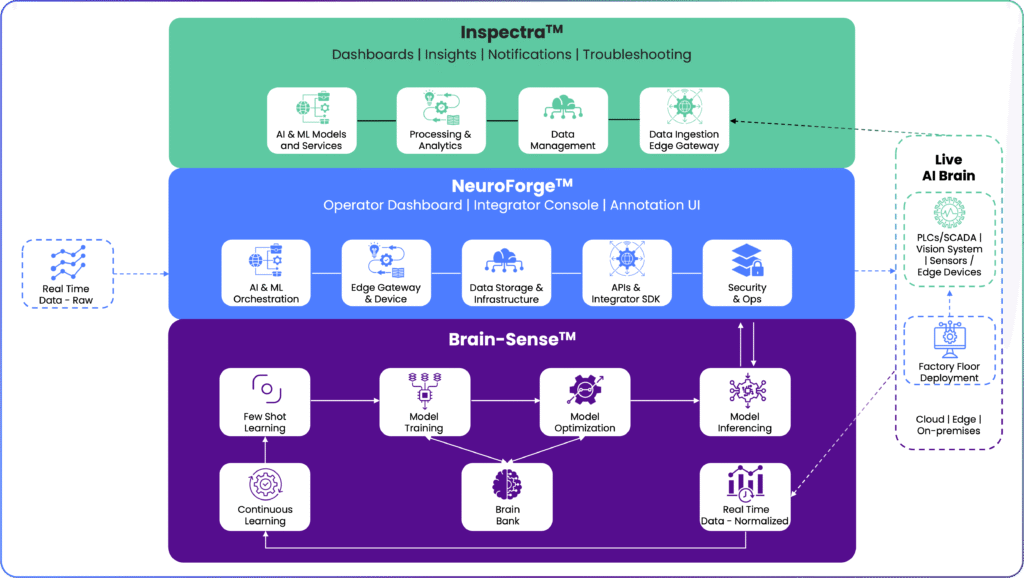
At Mindtrace, we don’t just use AI; we build AI. Our AI-first approach is fundamentally different because it’s engineered from the ground up to address these very challenges, moving beyond the limitations of generic tools or basic integrations.
- Dynamic Neural Networks for Adaptive Learning:
- Instead of static models, our Dynamic Neural Networks are designed for real-time adaptation. They learn continuously from new data, recognizing and classifying novel variations without extensive retraining. This means a slight change in material texture or lighting doesn’t break the system; it learns from it, maintaining high accuracy with minimal human intervention.
- Advantage: Our Brain-SenseTM brains are inherently robust to variations, reducing false positives and negatives as production evolves.
- Explainable AI (XAI) for Trust and Debugging:
- We bake explainability into our core architecture of InspectraTM, our analytics portal. Our brains don’t just make a decision; they can highlight why they made it, pinpointing specific features or regions that led to a classification. This transparency builds operator trust and dramatically accelerates debugging and process improvement.
- Advantage: Operators understand and trust our smart manufacturing platform, which facilitates rapid issue resolution and continuous improvement cycles.
- Few-Shot Learning and Efficient Data Utilization:
- Our expertise in brain-inspired computing allows us to achieve high accuracy with significantly less data. We focus on few-shot learning, enabling our models to generalize from very few examples of a new defect. This drastically reduces the annotation bottleneck and accelerates deployment for new product lines and defect types.
- Advantage: Faster deployment with NeuroForgeTM, lower data annotation costs, and quicker adaptation to new manufacturing challenges.
- Edge-Optimized Intelligence:
- Mindtrace builds AI that is efficient by nature and optimizes deployment at the edge. Our models are lightweight yet powerful, capable of real-time processing directly on existing industrial hardware, minimizing latency and reducing dependence on cloud connectivity.
- Advantage: The smart manufacturing platform has lightning-fast inspection speeds, maximum uptime, and reduced infrastructure costs.
The Future of Quality Inspection is Adaptive, Accurate, and Scalable
The promise of computer vision for quality inspection is real but realizing it in full-scale production requires more than just off-the-shelf tools or generic cloud platforms. It demands a deep understanding of AI principles and their application to complex, dynamic industrial environments.
At Mindtrace, our deep AI expertise sets us apart. We understand the nuances of vision – not just as a computational problem – but as a critical component of your operational excellence. If you’re tired of pilot project promises turning into production line headaches, it’s time to explore a solution engineered for true reliability.
Ready to move beyond the limitations and implement an AI vision system that truly performs?